
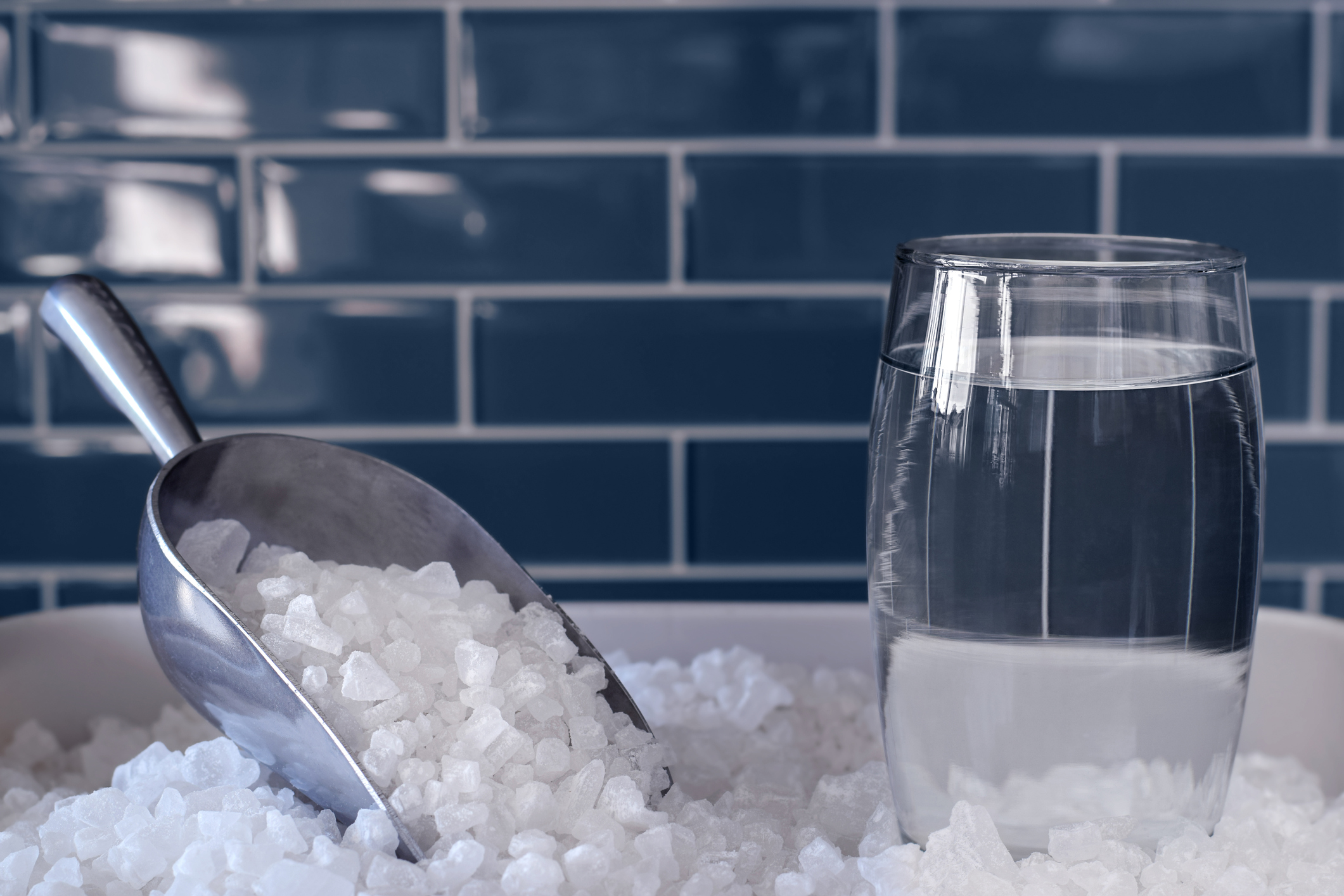
If you own a water softener, the salt you pour into the brine tank matters more than you might think. The right water softener salt keeps your system running efficiently for years. The wrong salt can clog your brine tank, damage the resin, and leave you back where you started: with hard water.
Hard water leaves limescale buildup, cuts the efficiency of water heaters, washing machines, and dishwashers, and dries out your skin and hair. A water softener solves this through ion exchange: tiny resin beads attract hardness minerals, then get cleaned with salt in a process called regeneration (or a backwash cycle). Without proper regeneration using high-quality salt, your softener quickly loses its ability to remove hardness. Using salt made for water softeners is not optional. It is essential.
How Salt Powers the Ion Exchange Process
- Hard water flows through the filtration tank.
- Hardness minerals stick to the resin.
- As more water is used, the resin becomes exhausted and needs to be recharged.
- During regeneration, a salt water solution is pumped from the brine tank into the filtration tank, then backwashed and rinsed to clean the resin.
This cycle repeats based on your water quality and usage. A typical household of four in Middle Tennessee can expect the system to regenerate about once every 5 to 7 days. The quality of your water softener salt directly impacts how cleanly and completely that regeneration happens.
Types of Water Softener Salt to Avoid
Not all salt is created equal, and the wrong type can cause serious problems:
- Ice-melt salt: Contains dirt, clay, and sometimes chemicals that clog the brine tank and ruin the resin.
- Table salt: Anti-caking agents, iodine, and other additives damage the resin.
- Pool salt: Crystal size and shape can cause salt bridging or mushing, which weakens the backwash cycle.
- Low-purity or off-brand salt: Leaves residue that reduces efficiency and forces more frequent regeneration cycles.
- Compressed pellets: The most common salt on store shelves, but pellets are prone to bridging and mushing, and many contain additives that can ruin specialized ion exchange media like Crystal Right.
The Best Salt for Your Water Softener
Our recommendation: high-purity salt crystals, ideally 99.5%+ pure sodium chloride. High-purity crystals dissolve cleanly, resist bridging, and give you the most efficient and effective regeneration cycle.
Sodium Chloride vs. Potassium Chloride
Most homeowners use sodium chloride because it is affordable (typically $9 to $12 a bag as of June 2026) and slightly more efficient. Potassium chloride is a solid alternative if:
- You are on a very restrictive low-sodium diet.
- You want to reduce sodium discharge into the environment.
The trade-offs:
- Potassium chloride costs significantly more ($40 to $50 a bag as of June 2026).
- It is less efficient, so you will use more of it.
- Some specialized ion exchange media cannot use potassium chloride at all.
The Bottom Line
Your water softener is an investment in better water quality and longer-lasting appliances. The right water softener salt protects the resin, keeps regeneration cycles efficient, and helps you avoid premature breakdowns. Cutting corners on salt costs more in the long run through maintenance, resin failure, and subpar water. If you are not sure which system or salt is right for your home, take a look at our whole home water treatment solutions or schedule a free in-home water test.
Have questions about your specific system? Email us at info@robertsonfamilywater.com and we will be happy to help.
Related Posts
How Water Filtration Extends Kitchen Appliance Life
Hard water quietly shortens the life of dishwashers, coffee makers, and ice makers. See what filtration and softening actually do for Middle Tennessee kitchens.
The Ultimate Guide to PFAS and Microplastics in Middle Tennessee Water
Two contaminants have taken over the water conversation so here’s The Ultimate Guide to PFAS and Microplastics in Middle Tennessee Water
The holidays are here and what better time to brush up on your hosting skills?! Secure your title as the best host this Christmas with these 5 tips! (Spoiler alert: these tips are good all year long, so be sure to take notes or bookmark this blog for future reference!)
1) Prepare a welcome basket for your guests!
Make your home feel a little more like your guests’ own with a welcome basket! Stock it with toiletries such as toothbrushes, toothpaste, shampoo, and conditioner, a magazine or two, a card with your wifi information, and maybe even their favorite Christmas candy! This is such a fun, festive way to welcome your guests into your home.
2) Make everyday items easy to find in your home!
While you might know where everything in your house is, your guests probably don’t! No one wants to snoop around your cabinets and drawers just to find some scissors. Go through your day and think about all of the household items you use on a regular basis, then make sure those items are easily accessible for your guests!
3) Prepare your food ahead as much as you can!
As easy as procrastination can be, preparation is key to being a better holiday host! With guests to entertain, your own family to take care of, and meals to cook, it’s easy to get bogged down in the to-do’s in the moment! That’s why committing to cleaning, chopping, and additional food prep ahead of time will help free up some much-needed time as you host!
4) Treat your guests to cleaner, healthier water!
Water is probably the most utilized resource throughout your entire home. From showers and baths to dinner dishes and delicious seasonal drinks, you and your guests will be using your water the duration of their stay. Make sure that yours is clean, safe, and healthy for all with a whole-house water filtration system! Not only will your guests thank you, but so will your family all year long! Enjoy healthier skin and hair, longer appliance life spans, brighter whites in the laundry, a lowered toxin burden, and more with a system! Learn more now by scheduling an appointment with one of our local water experts!
5) Give yourself some grace!
This might be the most important time we have. Hosting during the holidays can be stressful, so be sure to cut yourself a little slack! Your list might not get completely checked off, you might be a casserole, and you might have to run to the grocery store more than once, but remember that you are doing a great job and your guests are having a great time, no matter how overwhelmed you may feel! You can do it!
From welcome baskets to gifts of grace, we hope that you found these 5 tips helpful as you prepare to host this holiday season! If you are interested in learning more about how a whole-house water filtration system can be a gift for you, your family, your guests, and your home, schedule an appointment with us by clicking below! Hosting or not, we would be honored to help bring better water to your home this holiday season!
Hosting Thanksgiving or Friendsgiving this year? You’ve triple-checked the guest list, ironed the tablecloths, and prepped Grandma’s stuffing recipe, but have you considered the water coming out of your tap?
It might sound minor, but water quality can make or break the flavor of your food and drinks. From flat-tasting coffee to funky-tasting pasta water, poor water can sabotage your best dishes.
Let’s break down how to protect the taste of your holiday table from the top down, starting with what’s in your glass (and your pot, and your stock…).
Why Water Quality Impacts Taste
Water isn’t just a background ingredient; it’s often the main ingredient. Whether you’re boiling, baking, or brewing, if your water tastes like a chemistry experiment, your food will too.
Common Offenders in Tap Water:
- Chlorine – Adds a pool-water aroma to soups, sauces, and drinks.
- Hard Water Minerals (like calcium and magnesium) – Can leave a bitter, metallic aftertaste and mess with your bread rise.
- Sediment or Rust – No one’s asking for a side of iron oxide with their green bean casserole.
Clean water enhances the natural flavors of your ingredients. Dirty water dulls them or worse, alters them entirely.
The Holiday Menu Breakdown: Where Water Plays a Role
Here’s where clean water really struts its stuff on the holiday table:
1. Coffee & Tea
Using tap water for your post-feast coffee? Don’t. Minerals and chlorine kill the flavor. Clean, filtered water lets your beans and leaves shine.
2. Soups & Stocks
From turkey bone broth to butternut squash bisque, water is the base. Better water = richer, cleaner taste.
3. Boiled Veggies & Pasta
Hard water can toughen your green beans and affect pasta texture. Yes, even macaroni deserves clean water.
4. Baking Bread or Rolls
Chlorine can interfere with yeast, making your bread less fluffy and more “meh.”
5. Cocktails & Ice Cubes
Ever had a cocktail that tasted like tap? Not on your watch. Filtered water makes crisp ice and clean mixers.
Your Secret Ingredient? Clean Water.
We won’t crash your party with a sales pitch, but we will say this: If your water tastes off, it’s not your cooking, it’s your tap.
Family Water installs whole-home water filtration systems that:
- Remove chlorine and chemical contaminants
- Eliminate scale-causing minerals
- Make every drop taste fresher, smoother, and yes—more holiday-worthy
We’re the trusted local installers for Aquasana, the nation’s #1 direct-to-consumer filtration brand (backed by AO Smith). Translation: Big-league tech, hometown care. So if you’re prepping a feast and want it to taste its best, from cranberry sauce to coffee, we’re your flavor-saving sidekick.
Ready to make this your best-tasting holiday yet? Schedule your free in-home water test today. (No hard sell, no weird pressure—we’ll leave that to your extended family.)